Sankitha Kirindu

My Story

↓
PART I

My Story

Most of what I know, I learned by pressing a button to see what would happen.

The first one I ever hated was on an alarm clock. For most of my childhood, the day began with a negotiation between me and a 4:30 alarm. I lost every time.

By 5:10, my father and I were on the train from Padukka to Colombo, packed in so tightly that breathing felt communal. On the rare morning I found a seat, I slept against him. On the others, I watched the city arrive through a scratched window while the moon finished its shift.

Sankitha as a schoolboy holding an adult's hand on the platform at Padukka before sunrise, the train waiting Before sunrise, half awake, already moving toward something I wanted.

Even when it was the van, it was 5:25 at the door. This felt like enormous luxury and still required being awake.

Nobody told me what I was learning on that platform. I thought I was just tired. But it is the only reason the rest of this page makes sense. Mathematics, code, swimming, chess and weights look like separate hobbies from the outside. From the inside they are one habit in different clothes: turn up, notice what is wrong, go back tomorrow.
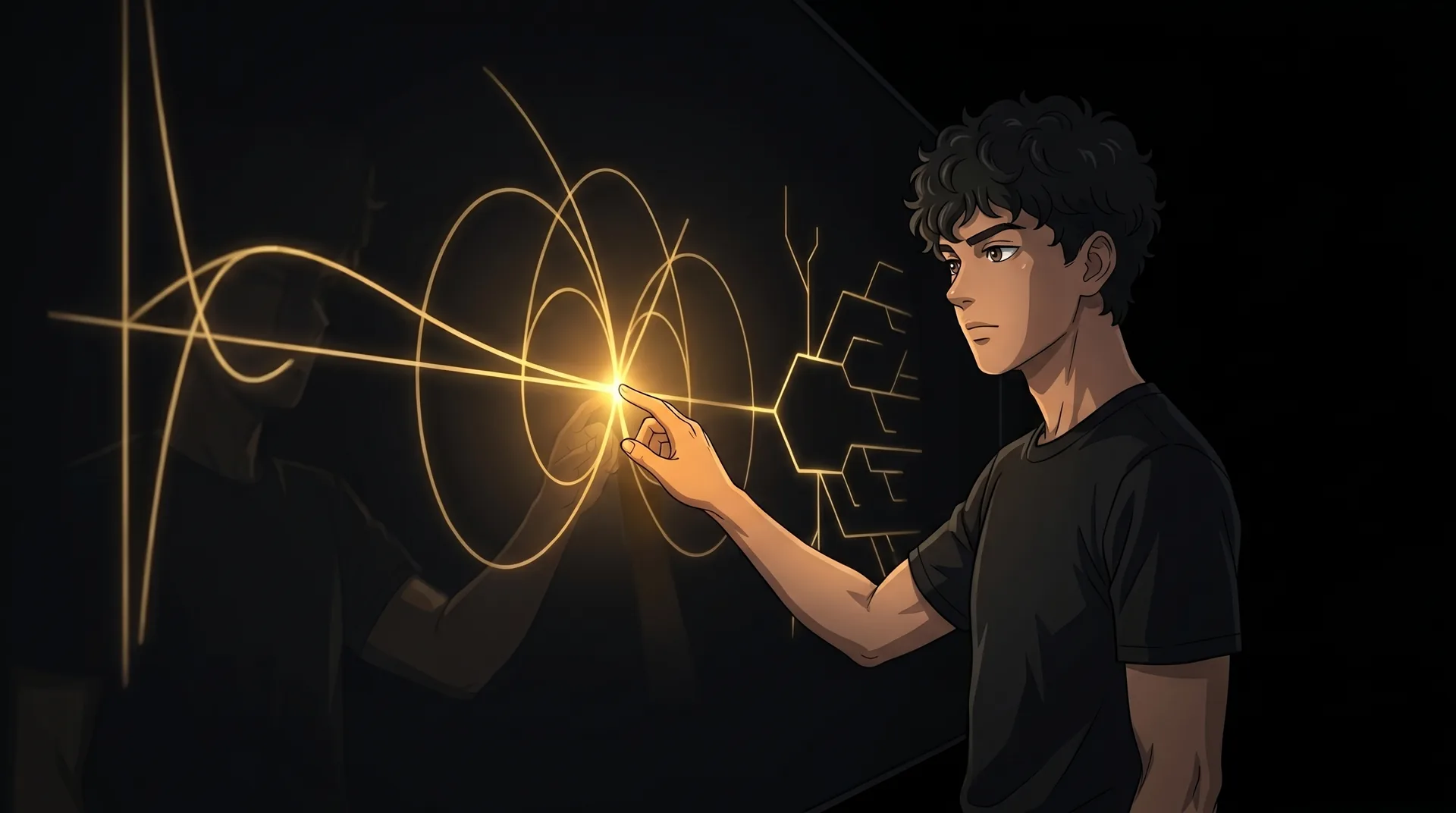
Sankitha touching the glowing point where a mathematical curve, a physics diagram and a program meet Finding the hidden mechanism where mathematics, physics, and computer science quietly overlap.

Mathematics told me a correct answer still owes you an explanation. Physics showed me the machinery under ordinary things. Computer science let me build the machinery myself, at which point it broke and I learned more. When a topic was removed from the Further Mathematics syllabus, most people treated it as a small administrative victory. I asked my teacher for the reading, because I wanted to know what happens when data refuses to behave.

A lot of this happened through a laptop, on Zoom links that appeared to hold a philosophical opposition to functioning. When the electricity went, I rejoined on mobile data. When class ended, I stayed online until the gaps closed. Nobody else was going to close them, which turned out to be the most useful thing about it.

Eventually that curiosity got a job. At Saizen Acuity I build automations, workflows and digital experiences, the things that take scattered work and give it somewhere to live. I was very pleased with my early ones. Then one night I watched a workflow I had designed fail silently in production. The logic was clean, the branches connected, and the system simply did not understand the world as well as I thought it did. A senior engineer asked me, “What happens when this assumption is wrong?” I did not have an answer. I have asked that question of everything since.

Saizen also put me in rooms I used to imagine from very far away, with leaders, engineers and advisors from Google, Microsoft and other major technology companies. I am usually the youngest person there and occasionally the least qualified to have an opinion. I have one anyway. Getting it challenged, then learning to defend it or drop it without sulking, has done more for me than most of my grades.
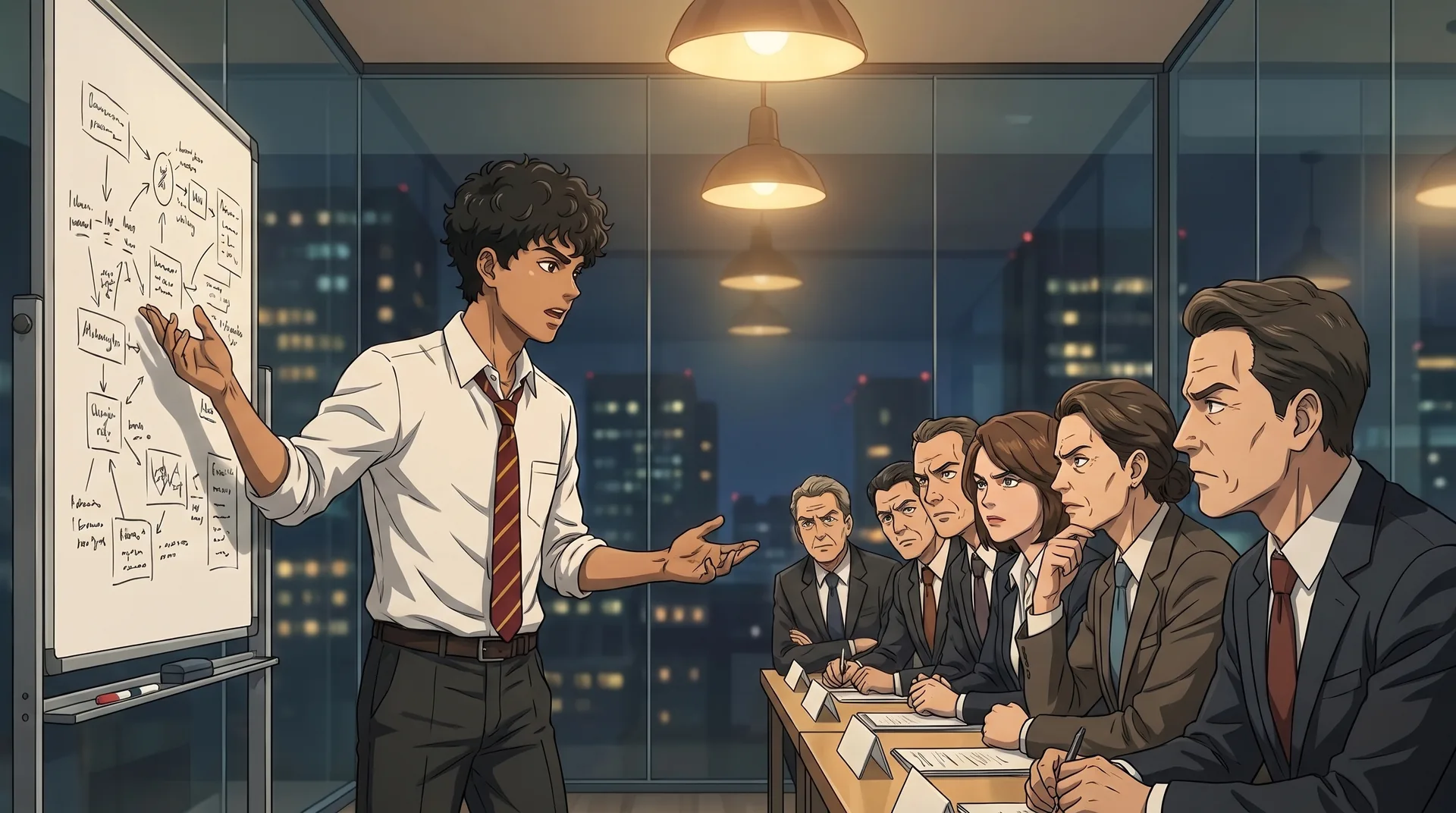
Sankitha at a whiteboard making his case to a table of senior colleagues Expected to contribute, and to defend the decision afterwards.

So: student, programmer, athlete, builder. All accurate, none of them the honest answer. The honest answer is that I am still the kid on that train, looking through a scratched window at something I have not worked out yet.

The questions have improved. The sleep has not.
✦
PART II

Childhood

It started with small machines and unnecessary questions.

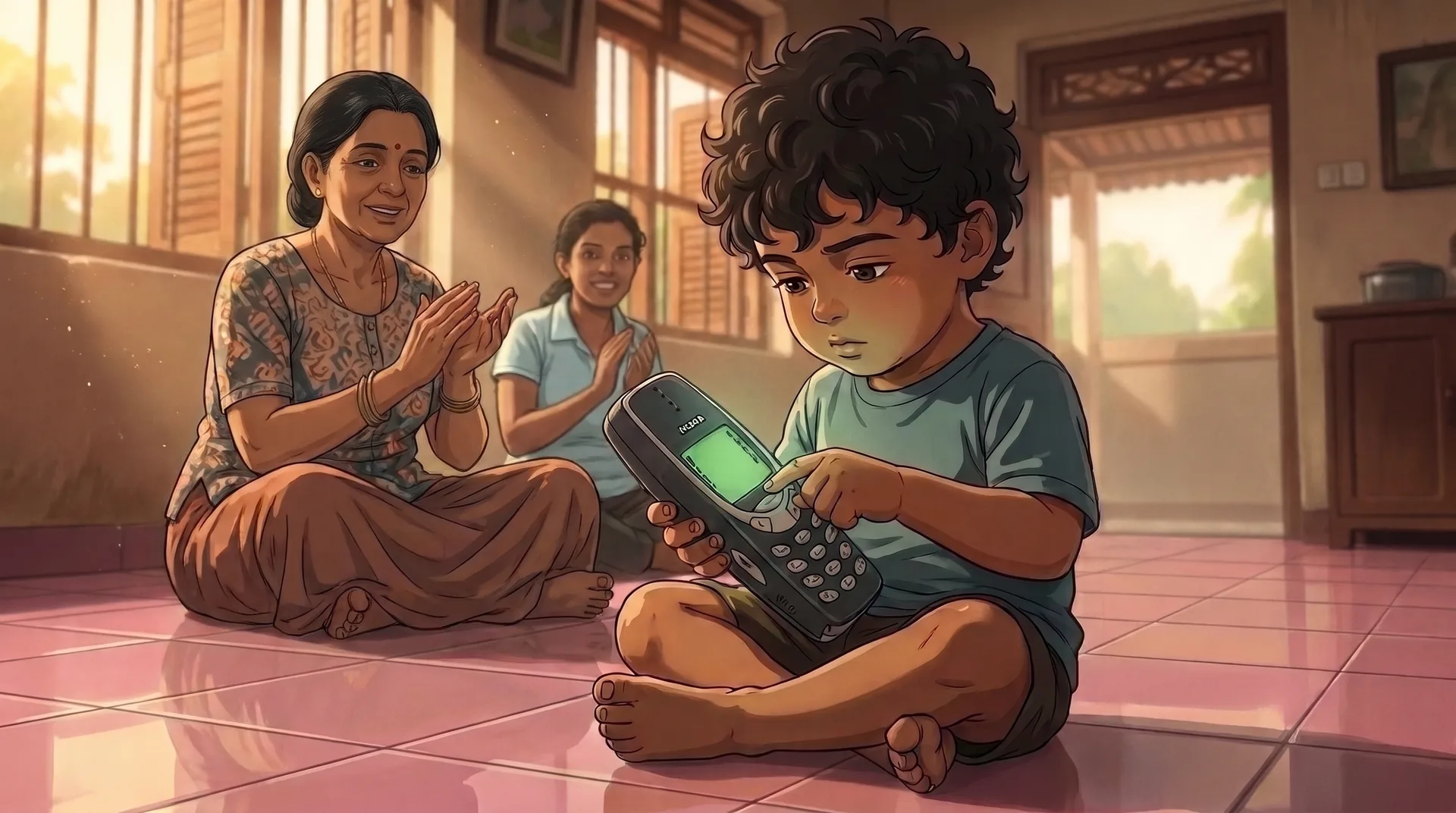
One of my earliest memories is my grandmother’s Nokia refusing to ring. Nobody expected a toddler to fix it, which was convenient because neither did I. I pressed buttons I did not understand, one after another, until the sound returned. Everyone celebrated. I mostly remember the tiny thrill of finding the right button and watching a stubborn object suddenly behave.

That feeling became addictive.

Sankitha as a small child fixing an old Nokia on the floor while his grandmother claps Small machines, questionable experiments, and the curiosity that refused to stay small.

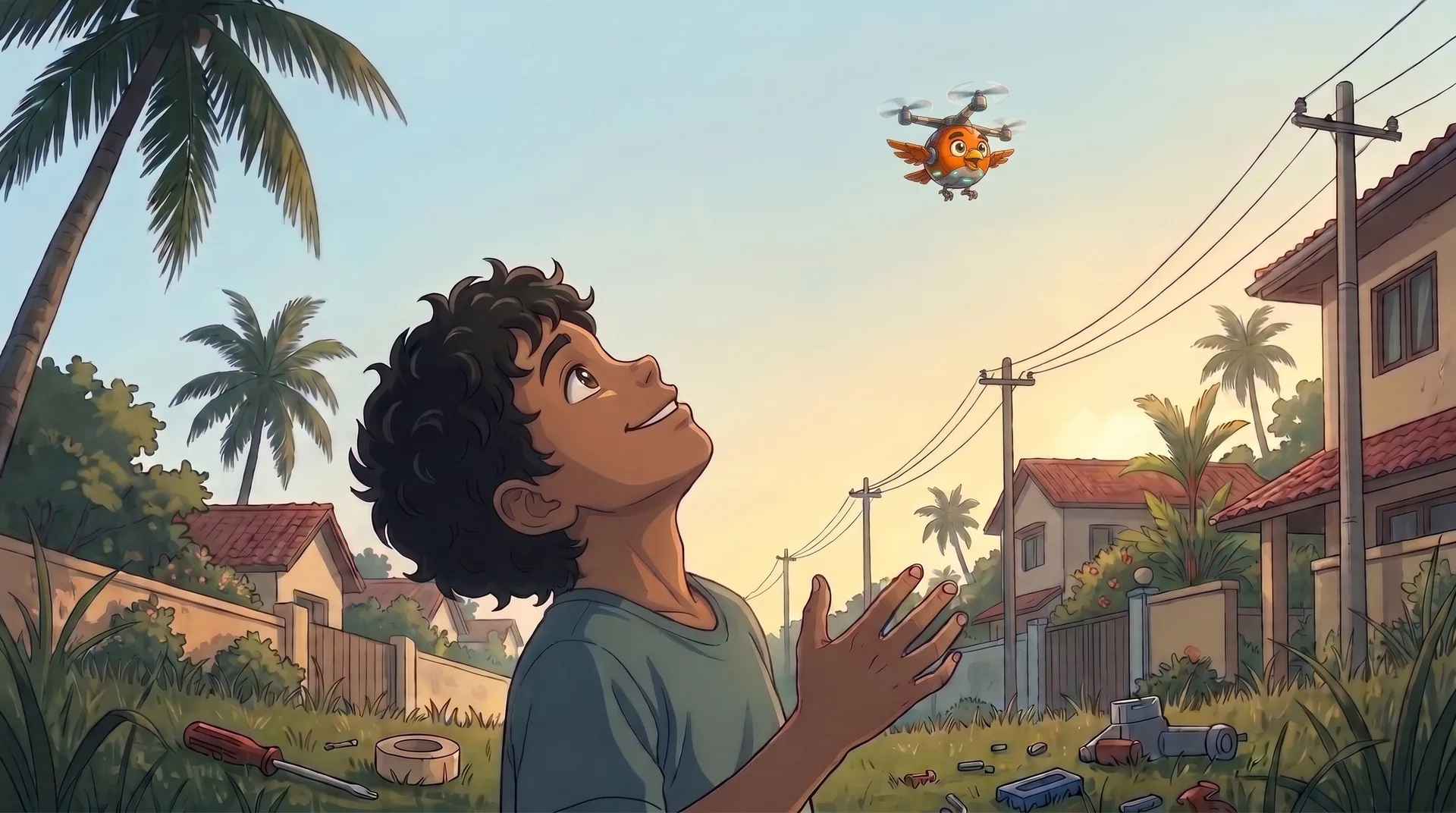
A few years later, I dismantled three toy helicopters and combined their motors into one deeply questionable flying object. It looked wrong, flew once, and then kept flying until it vanished into the sky. I was proud, heartbroken, and completely convinced I had discovered something important. The lesson survived the helicopter: ridiculous ideas deserve a proper test before anyone gets to dismiss them, because occasionally the ridiculous thing actually flies.

Sankitha as a boy in the garden, looking up as his homemade flying machine climbs away Three motors, one flight, no return.

None of this felt like preparation for anything. Discipline did not arrive as a motivational quote. It arrived as an alarm in the dark, a bag of books, and a routine that did not care whether I felt inspired.

That childhood made me curious, but it also made me suspicious of ideas that only sound clever. A phone should ring. A toy should at least attempt to fly. A program should survive bad input. A routine should eventually produce evidence. I like imagination, but I like it tested.

The toddler with the phone and the boy watching his helicopter leave forever are, I have since realised, the same person. Some things come back working. Some things are still up there.

✦
PART III

Now & Future

Right now, I am doing the equivalent of two jobs, and neither of them is my degree.

At Saizen Acuity I work on a number of projects at once: automations, workflows, data and digital experiences for people who need them to still work next week. Alongside that I am building something of my own, which is still in progress and which I will describe when it deserves it. And at Heriot-Watt I am reading Electrical and Electronic Engineering, one of the most in-demand degrees there is, with an average above 98% across my modules.

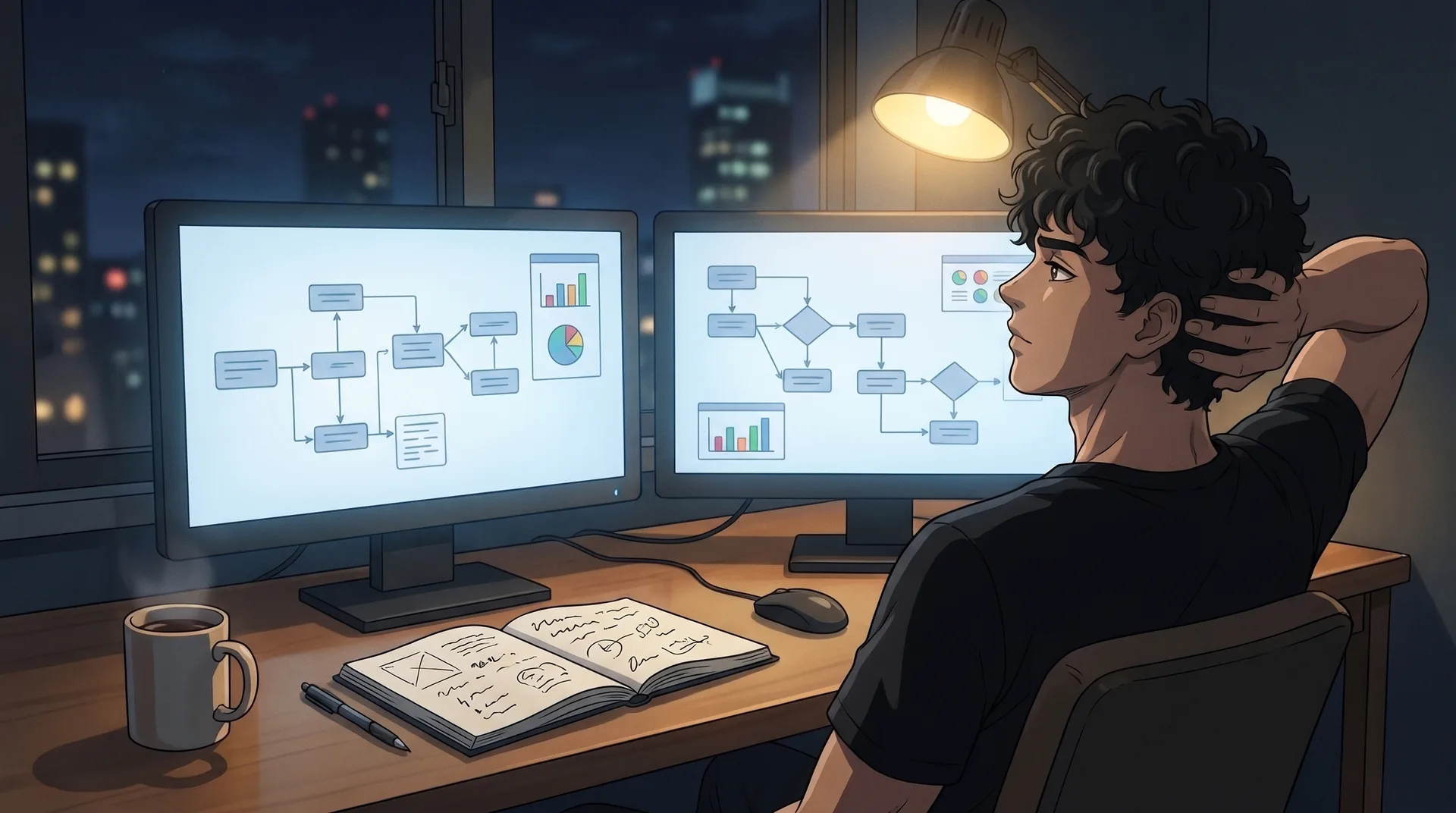
Sankitha leaning back at his desk at night, thinking, with workflow diagrams on two monitors The coffee is not a prop.

I would love to tell you this is all very balanced. It is not. Some weeks the calendar wins, the sleep loses, and I find out exactly how much a body will tolerate before it files a complaint. It works at all because none of it is really separate. A statistics lecture turns up in a data pipeline by Thursday. A failure at work sends me back to the textbook. The pool is the one place nobody can message me.

I care about the whole chain. A beautiful website that nobody understands is bad design. An automation that breaks on the first weird input is a demo. A workflow that connects twelve tools but saves nobody time is decoration.

What I believe now sounds much less impressive than what I believed at sixteen: validation before confidence, fallbacks before elegance, human review before anything irreversible.

The curiosity has not grown up at all. It is the same embarrassing habit I had at three, on my grandmother’s Nokia. The world just keeps giving me bigger buttons to press, with more riding on what happens next.

Long term, I want to build systems that give people their time back, especially people and organisations whose ambition is larger than the infrastructure supporting it, without ever reducing anyone to an input. I am always looking for the next big button to press.

Family

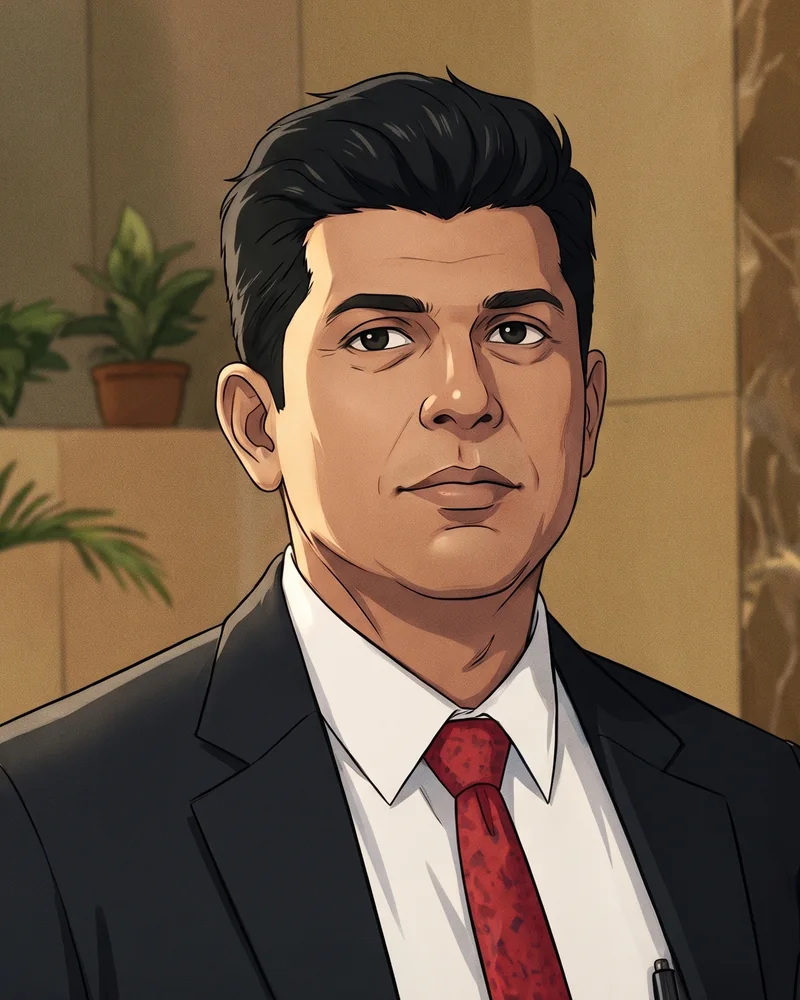
Illustrated portrait of Namal Premawardana
Father Namal Premawardana Senior Supreme Court Lawyer | Attorney At Law
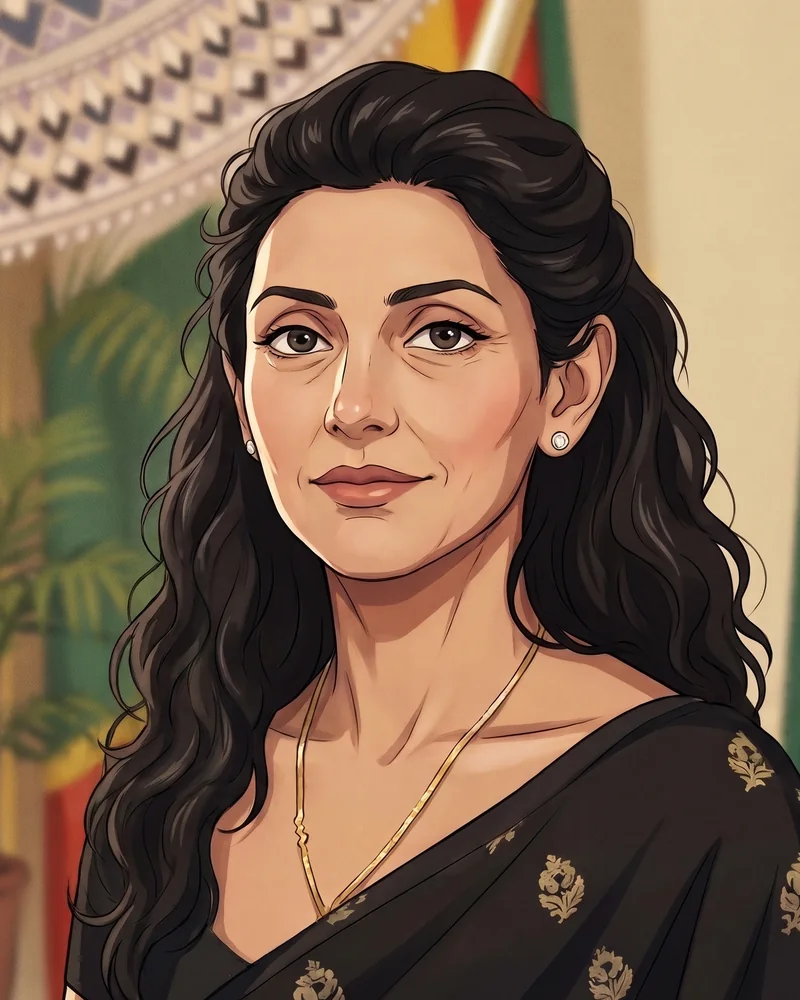
Illustrated portrait of Devanthi Jayasooriya
Mother Devanthi Jayasooriya Teacher | Mathematics & Science
Illustrated portrait of Sehasna Premawardana
Sister Sehasna Premawardana Student | A-Level
01 // PROFESSION

WORK

✦
Sankitha walking through a server room aisle with a laptop under his arm
SYSTEMS // AUTOMATION // LEVERAGE
[

“THE BEST LEVERAGE REMOVES WORK YOU SHOULD NOT REPEAT.”

]
A

DECADE OF THIS, AND IT STARTED WITH A PERSONAL WEBSITE.

Nobody makes a career plan at nine. I had a personal website I wanted to build and no idea how, so I found out. Then it needed to be faster, so I found that out too. Websites became analytics problems, analytics became automation, and automation became data architecture. A decade later the problems belong to other people and cost considerably more when they break, but the method has not changed: there is a thing I want to exist, and it does not work yet.

CURRENT FOCUS
AI & SYSTEMS
AT SAIZEN ACUITY
CAPABILITIES

AI AUTOMATION

Building intelligent agents and context-aware workflows.

</>

WEB DEVELOPMENT

Creating clean, premium, high-performance web applications.

DATA WORKFLOWS

Structuring data so complicated systems keep moving cleanly.

GEO & SEO

Making systems easier to find through search and answers.

THE QUESTION

One of my workflows once failed silently in production. A senior engineer asked me, “What happens when this assumption is wrong?” I have been asking it ever since, usually earlier than is convenient.

See where it goes
02 // INTELLECT

ACADEMICS

✦
Sankitha in a suit with his medal and Cambridge Outstanding Learner Awards booklets
DISCIPLINE // DEPTH // DIRECTION
[

“UNDERSTANDING THE STRUCTURE IS USUALLY FASTER THAN MEMORIZING THE ANSWER.”

]
A

CADEMIC RIGOR TAUGHT ME TO LIKE THE UGLY PART FIRST.

My school did not offer Cambridge A-Levels, so I did them privately, on a laptop, through power cuts and storms, with both stages of Mathematics, Further Mathematics, Physics and Computer Science sat in one year. What got me through was hours, a lot of them. What made the hours bearable was that this never felt like four subjects. The ripple on a pool, the spiral in a shell, the way a loop settles: the same few patterns keep turning up, and once you notice them you cannot stop looking. It felt less like memorising and more like learning to read.

CAMBRIDGE A-LEVELS
4 A*s
ACHIEVED WITH DISTINCTION
SUBJECTS
Σ

MATHEMATICS

Proof, patterns, and finding why an answer must be true.

∫

FURTHER MATHEMATICS

Exploring advanced methods and abstract thinking.

PHYSICS

The rulebook underneath motion, matter, electricity, and machines.

</>

COMPUTER SCIENCE

Turning logic into algorithms, then useful systems.

REAL CONSEQUENCES

Theory gets better once it has real consequences. At sixteen, that meant writing my own compiler to find out how one works. Later it meant Magic Box, a mathematics programme that has reached over 2,000 students, where a bad explanation gets found out immediately.

Read about Magic Box
03 // PHYSICAL

SPORTS

✦
Sankitha before, much heavier in a white polo shirt, and now, flexing both arms in the gym
DISCIPLINE // ENDURANCE // RESILIENCE
[

“THE BODY IS A VERY RUDE BUT VERY ACCURATE PROGRESS REPORT.”

]
E

LEVEN YEARS IN THE WATER. THE WEIGHTS CAME LATER.

I swim because I have done it for eleven years and the water still does not care how my week went. I lift because the bar does not care either, which after a long day is oddly restful. I spent some years in wushu too, and it still turns up in my balance. None of this is very heroic. Some weeks it happens on almost no sleep and the numbers show it. But it is the one part of my day nobody has asked me to scale.

TRAINING FOCUS
3 DISCIPLINES
SWIM // WEIGHTS // WUSHU
PRACTICES

SWIMMING

Eleven years of breath control, rhythm, and another lap.

WEIGHTLIFTING

Slow progress, heavy things, and the patience to repeat it next week.

WUSHU

A few years of forms. These days it mostly shows up as balance.

ENDURANCE

Staying useful under fatigue, recovering quickly, and keeping technique intact.

LAP THIRTY

Around lap thirty, the body opens negotiations. You learn not to take the meeting. Hard training makes long technical days less dramatic.

Read about the swimming
08 // Let's Connect

If Something Here Resonates

Technical problem, academic question, collaboration, or serious opportunity: if there is substance behind it, I am open to talking.