Chess
Discipline without motion.
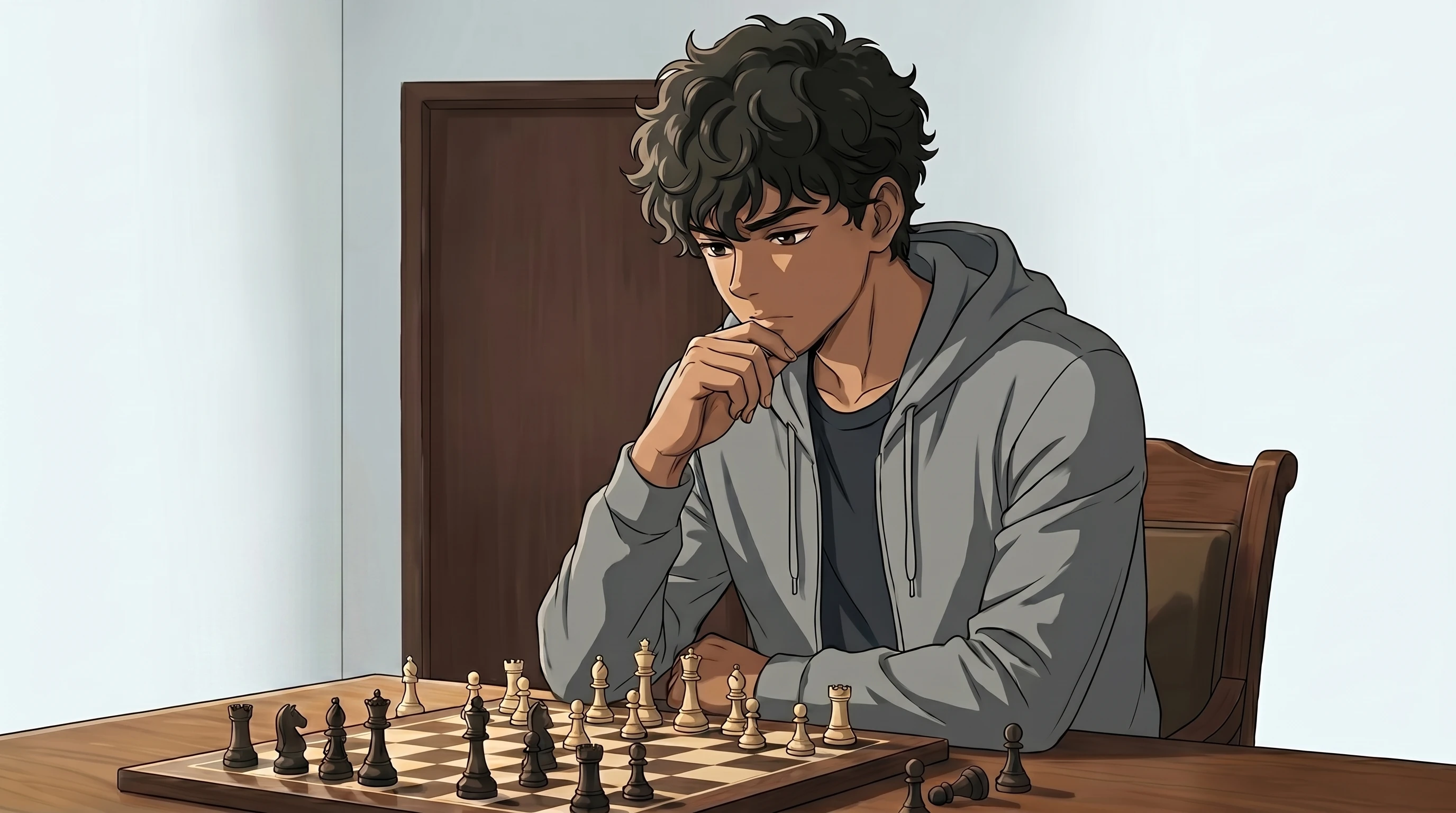
Chess trained a different kind of athleticism.
Chess looks calm outside. Inside, every move creates futures and kills others. A tiny weakness can survive ten moves before becoming expensive, and an advantage means nothing until you convert it patiently.
Chess trained me to think one consequence past the obvious move, then ask what I am giving away.
Strategic Foundation
Over a decade of deep involvement in tactical competition.
Visualizing candidate moves and trade sequences before execution.
Methodical board build-up, waiting for opponent structural weakness.
Identifying geometry changes and applying tactical schemas.
Thinking Under Consequence
Four lessons. Each transferred beyond the board.
Patience
The best move is often boring. Chess punishes the urge to do something dramatic just because the position has been quiet for too long.
Calculation
Every move is a trade between futures. The useful question is not only what changes now, but which options still exist three decisions later.
Sacrifice
Sometimes the right move looks worse first. Chess made me comfortable paying a visible cost for a stronger position later.
Conversion
A winning position is only potential. You still have to convert it patiently.
Decision Tree & Pruning
I built this to see how an engine actually decides, and now you can use it too. Adjust the parameters and watch a minimax search evaluate lines and prune the weak ones.
Play With Me
You play White. Choose which version of me you want to face - from toddler to present day. Age 1 just moves pieces around, so anyone can beat it. Every age after that plays more of its moves from Stockfish 18 NNUE, running live.
The Geometry of Possibility
Three more old experiments, left here to play with: how fast chess explodes, the wheat on the chessboard, and why pruning matters.
Combinatorial Expansion
Calculates the total possible game trajectories as a function of depth (plies/half-moves).
Exponential Growth
Visualizes the legendary wheat problem: placing grains on a chessboard, doubling each square.
Search Tree Optimization
Compares pure search (Minimax) vs. optimal search with Alpha-Beta pruning (assuming a branching factor of 30).
Quiet Pressure
Chess is not about moving fast.
Good chess is understanding the position deeply enough that the right move becomes obvious.
That habit followed me into technical work: map the system, find the pressure points, calculate consequences, resist the tempting shortcut, then execute without creating a new problem somewhere else.
“EVERY MOVE BUILDS ONE FUTURE, CLOSES ANOTHER, AND CHANGES WHAT BECOMES POSSIBLE NEXT.”