
Mathematical Machine Learning & Symbolic Regression
Functional AI
Symbolic Mathematical Discovery Algorithm
Oct 2026 – Dec 202620Adversarial functions
230Training points
86Holdout points
9 + 1 equivalentTarget structures recovered (retest)
Look Inside
Overview
I am independently developing a mathematical engine that discovers interpretable equations from (x, y) observations. Unlike interpolation, the system searches across function families, optimises parameters and tests how well each candidate predicts unseen points.
What It Delivers
- Symbolic candidate generation across polynomial, rational, logarithmic, exponential, trigonometric and composite functions.
- Numerical parameter fitting and expression refinement in Python.
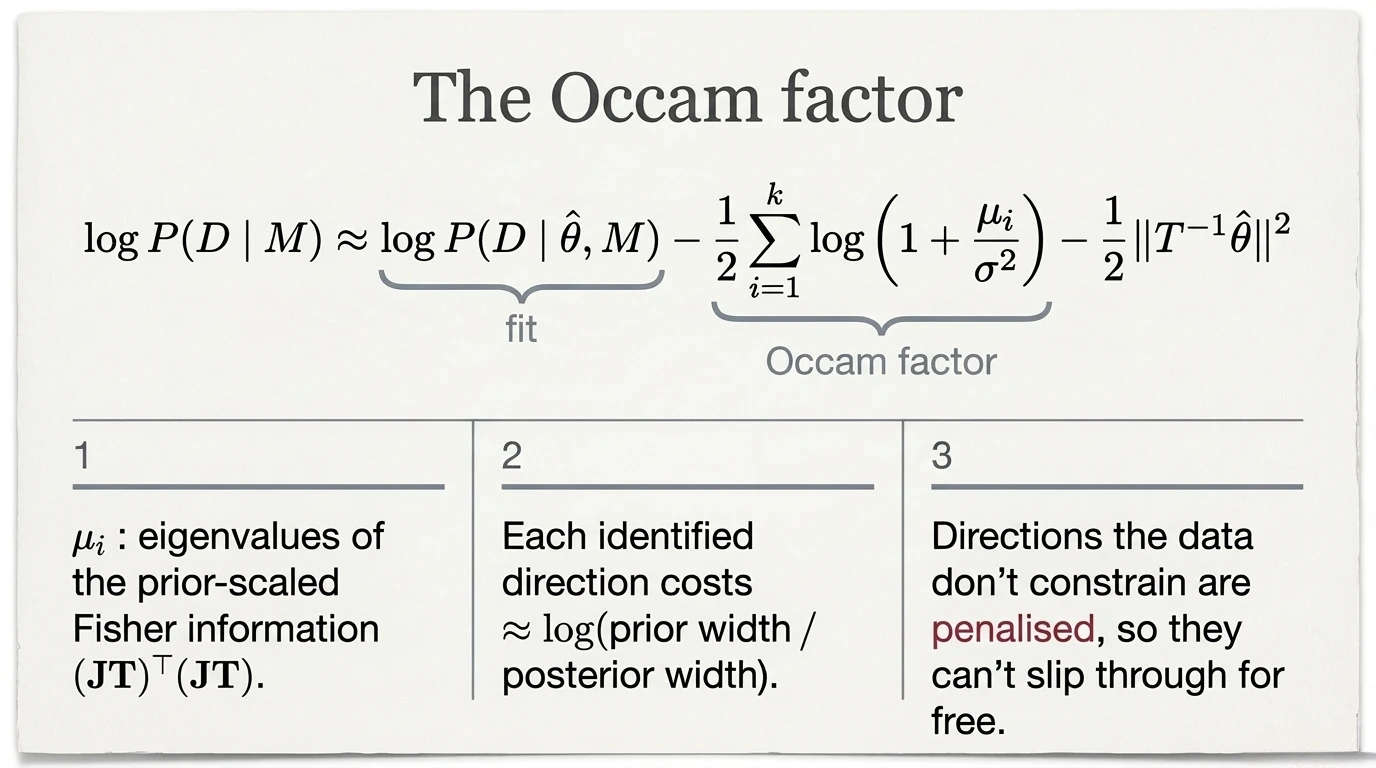
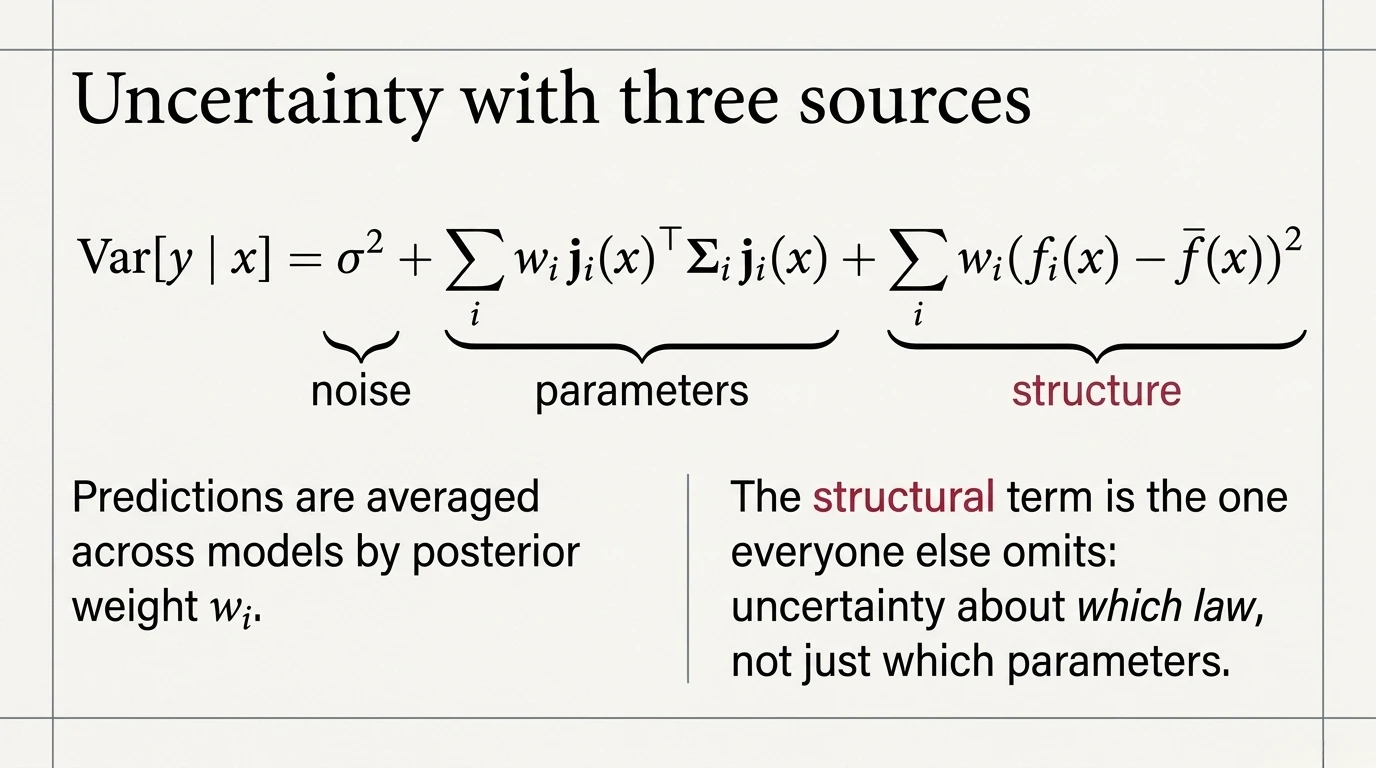
- Scoring that balances predictive error, mathematical complexity and alternative explanations.
- Leave-one-out testing, holdout evaluation, residual inspection and relative evidence ranking.
What I Did
- Implemented symbolic candidate generation for polynomial, rational, logarithmic, exponential, trigonometric and composite functions.
- Built numerical parameter fitting and expression refinement workflows in Python.
- Designed scoring across predictive error, mathematical complexity and alternative explanations.
- Added leave-one-out testing, holdout evaluation, residual inspection and relative evidence ranking.
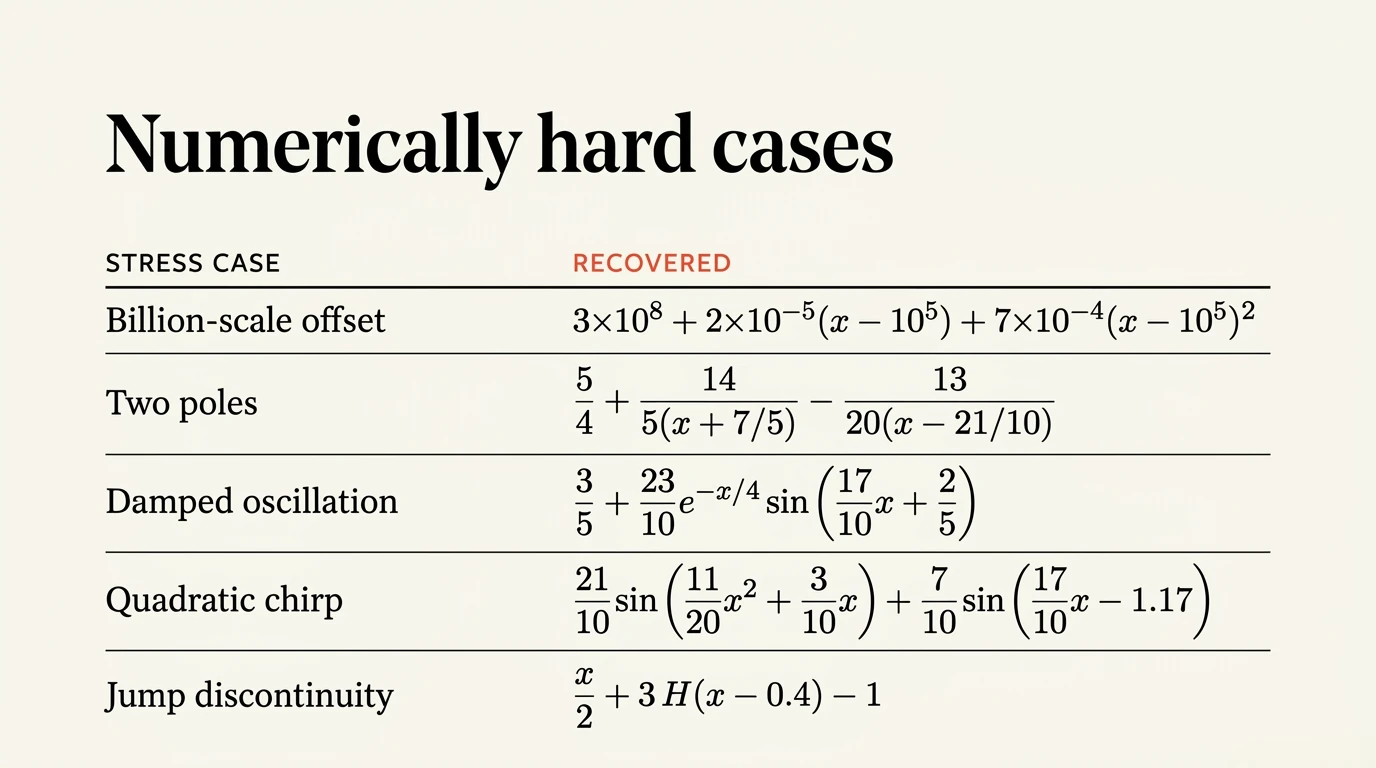
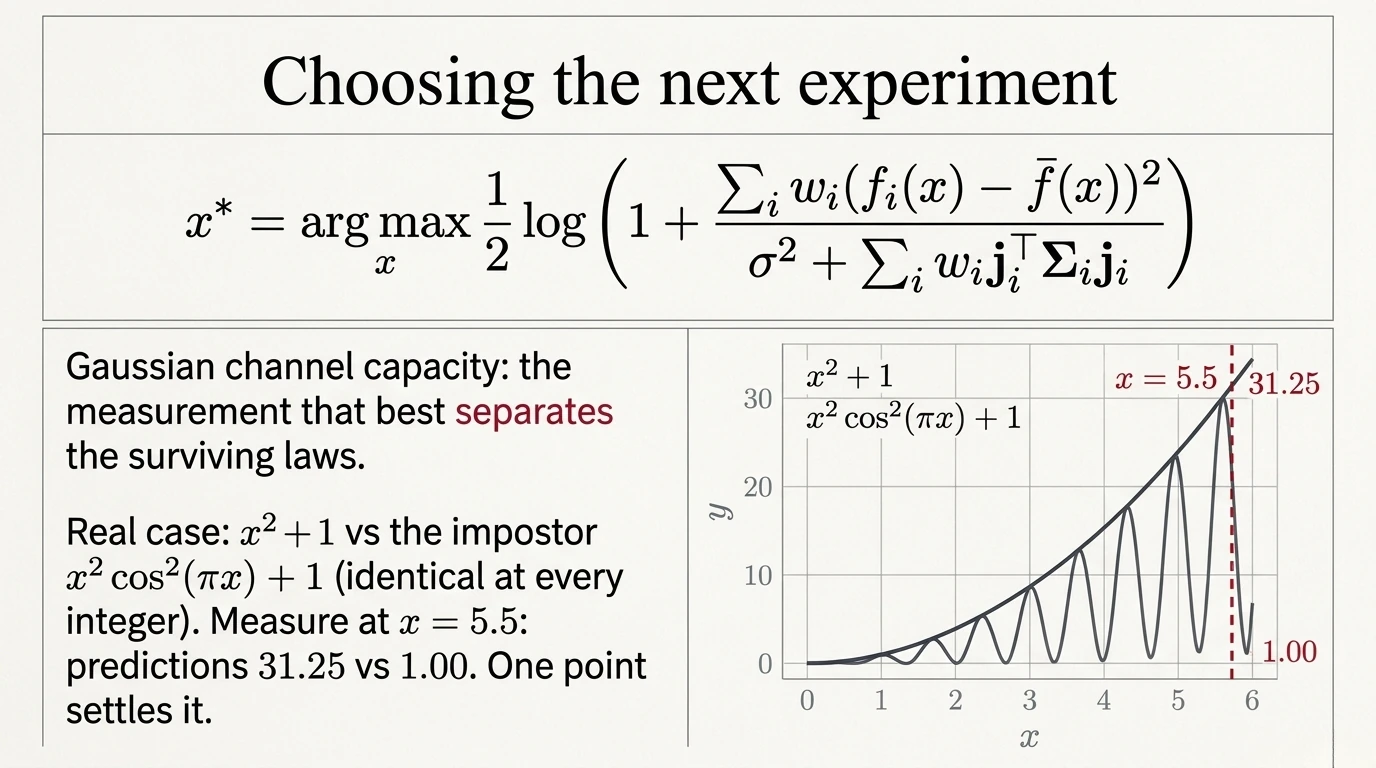
- Developed adversarial test sets covering oscillation, discontinuities, nested functions, close frequencies and misleading fits.
- Investigated numerical instability, domain errors, overfitting and equivalent expressions that appear structurally different.
- Used documented regression failures to revise the search and selection algorithms across versions.
Outcomes
- An earlier 25-case diagnostic run identified 20 target cases.
- A later 20-equation adversarial retest recovered 9 target structures plus 1 domain-equivalent result.
- Unresolved failures in difficult nested and composite expressions were exposed and now guide further development.
Proven Impact
- 20 adversarial functions, 230 training points and 86 holdout points in the current test set.
- Status: active independent R&D. These are internal test results, not benchmark-superiority claims.
Why It Matters
- The goal is to derive mathematical models that engineers and researchers can inspect and challenge, instead of producing only a numerical curve fit.
A curve fit tells you what the data did. An equation is an argument about why, and it can be checked.