
Applied AI, Retrieval & Health Data
Bump4Life AI
Longitudinal Health-Data Intelligence
Sep 2025 – Present97.0%Correct answers
3.0sMedian response
37,613Records in benchmark
60%Fewer errors vs ChatGPT
Look Inside
Full report
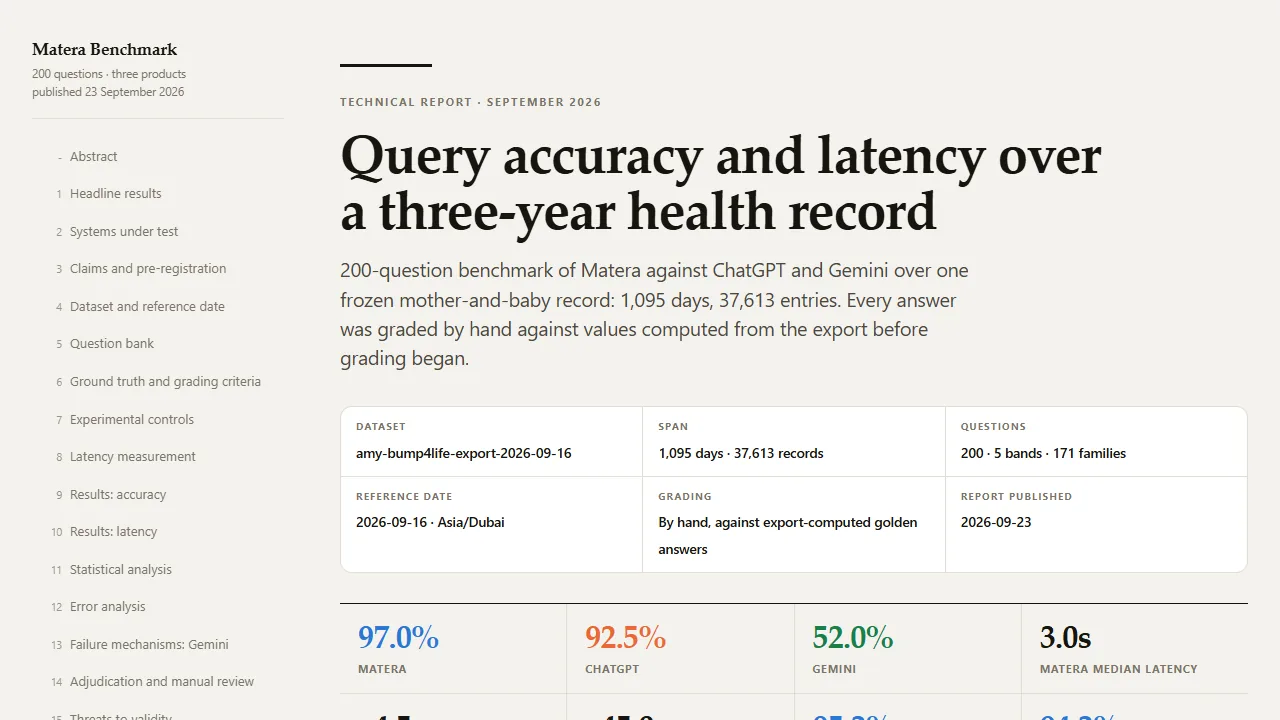
Matera Benchmark: 200 Questions, Three Products
The full technical report: Matera against ChatGPT and Gemini over one synthetic three-year mother-and-baby record, every answer graded by hand. Accuracy, latency, statistics and the appendix of per-question results.
Read the reportOverview
I engineered the AI system behind Bump4Life to answer specific questions about years of maternal and child health data. Rather than repeatedly feeding an entire record to a language model, the system retrieves the relevant entries, performs calculations against structured data and generates a contextual answer.
What It Delivers
- Targeted retrieval of the relevant entries instead of sending an entire record to the model.
- Deterministic calculations against structured data, separated from language-model explanation.
- Handling for time-series queries, totals, rankings, date-specific lookups and comparisons across multiple records.
What I Did
- Built the integration between health records, retrieval tools, contextual memory and language-model responses.
- Designed handling for time-series queries, totals, rankings, date-specific lookups and comparisons across multiple records.
- Separated deterministic calculations from language-model explanation to reduce avoidable numerical errors.
Outcomes
- Benchmark (Sep 2026) on one frozen synthetic record: 37,613 entries spanning 1,095 days.
- Strongest relative gains in multi-record retrieval and top-N rankings.
Proven Impact
- Bump4Life AI: 194/200 correct (97.0%). ChatGPT: 185/200 (92.5%); Gemini: 104/200 (52.0%).
- 60% fewer incorrect answers than the tested ChatGPT configuration.
- Median response of 3.0 seconds versus 62.0 seconds for ChatGPT, approximately 21× faster.
Why It Matters
- The benchmark shows what targeted retrieval and reliable computation can add to an LLM-based application.
- Results apply to this controlled synthetic-record test, not clinical diagnosis or general model superiority.
Let the model explain. Let the code count.