
Numerical Analysis & Algorithm Design
Polynomial Detection System
Exact Polynomial Reconstruction
Aug 2025O(n²)Construction
O(n)Evaluation
ExactCoefficient precision
Look Inside
Overview
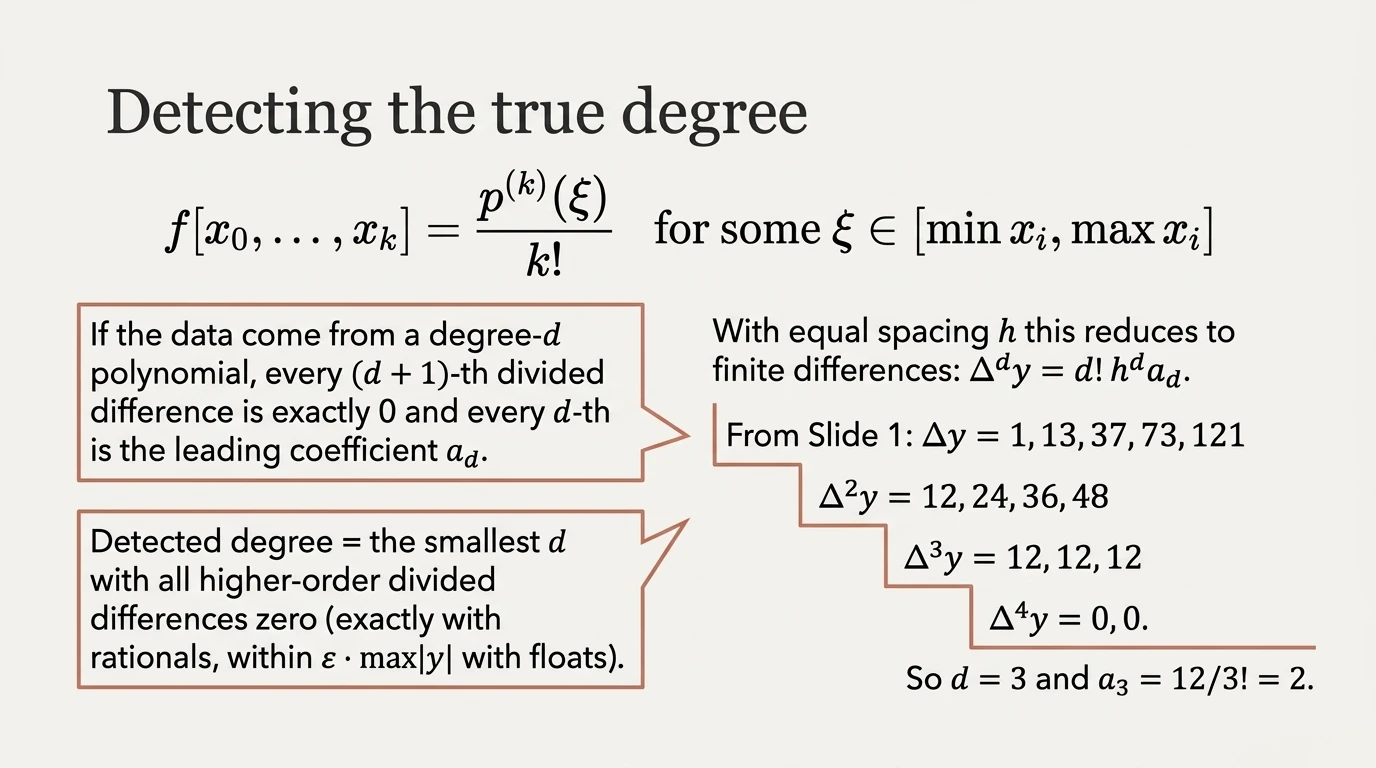
I developed a mathematical interpolation system that reconstructs the unique polynomial of degree at most n − 1 through n points with distinct x-values, then determines the lowest degree consistent with those observations. Exact rational arithmetic preserves coefficient precision without floating-point rounding.
What It Delivers
- Exact interpolation for distinct x-values, with degree detection rather than assuming degree n − 1.
- Rational coefficients and symbolic expressions suitable for further mathematical analysis.
- Explicit reporting when no lower-degree polynomial is established by the data.
What I Did
- Implemented Newton divided differences for incremental polynomial construction and degree identification.
- Used higher-order zero differences to detect when a lower-degree polynomial explains all supplied points.
- Represented decimal inputs as rational fractions, performing coefficient calculations exactly.
- Converted Newton-form polynomials into conventional coefficient form using nested multiplication.
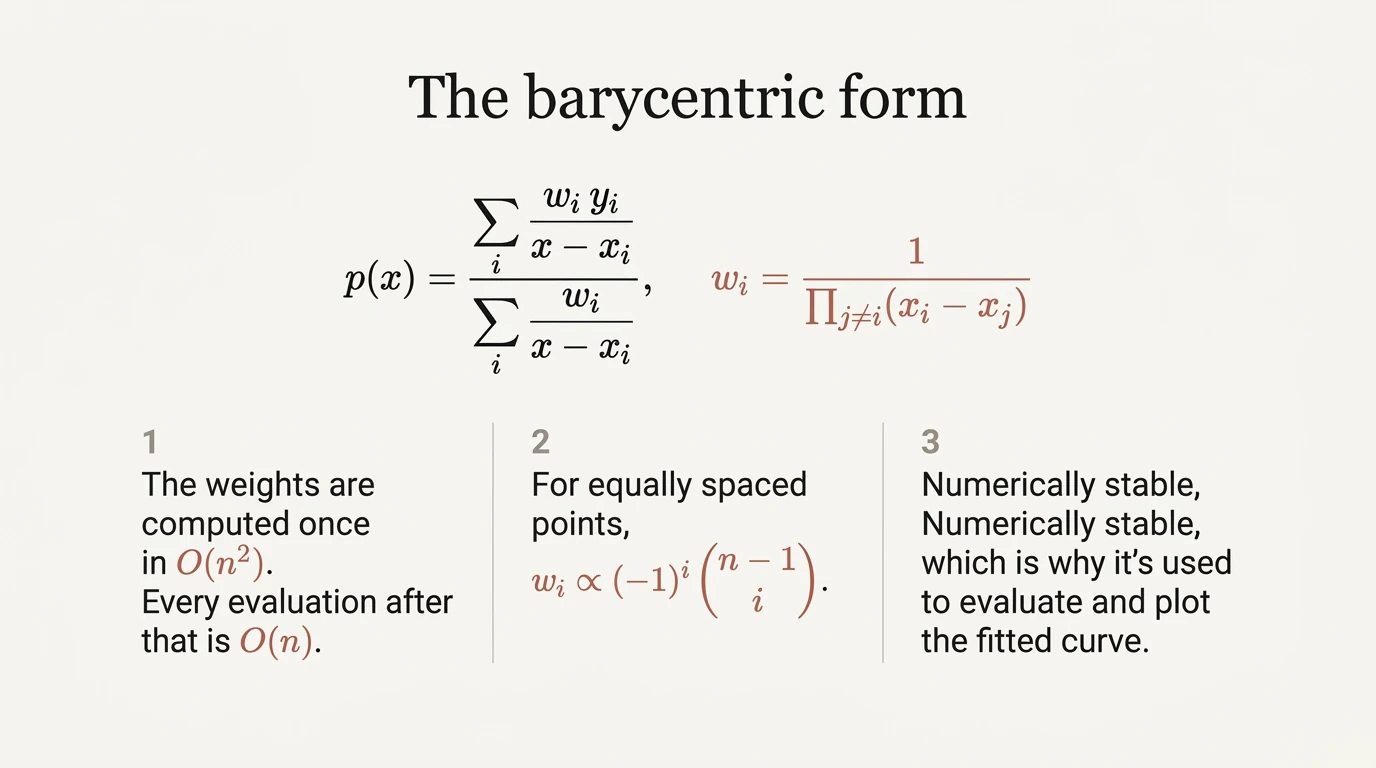
- Applied Lagrange interpolation and barycentric evaluation for an alternative mathematical representation and efficient plotting.
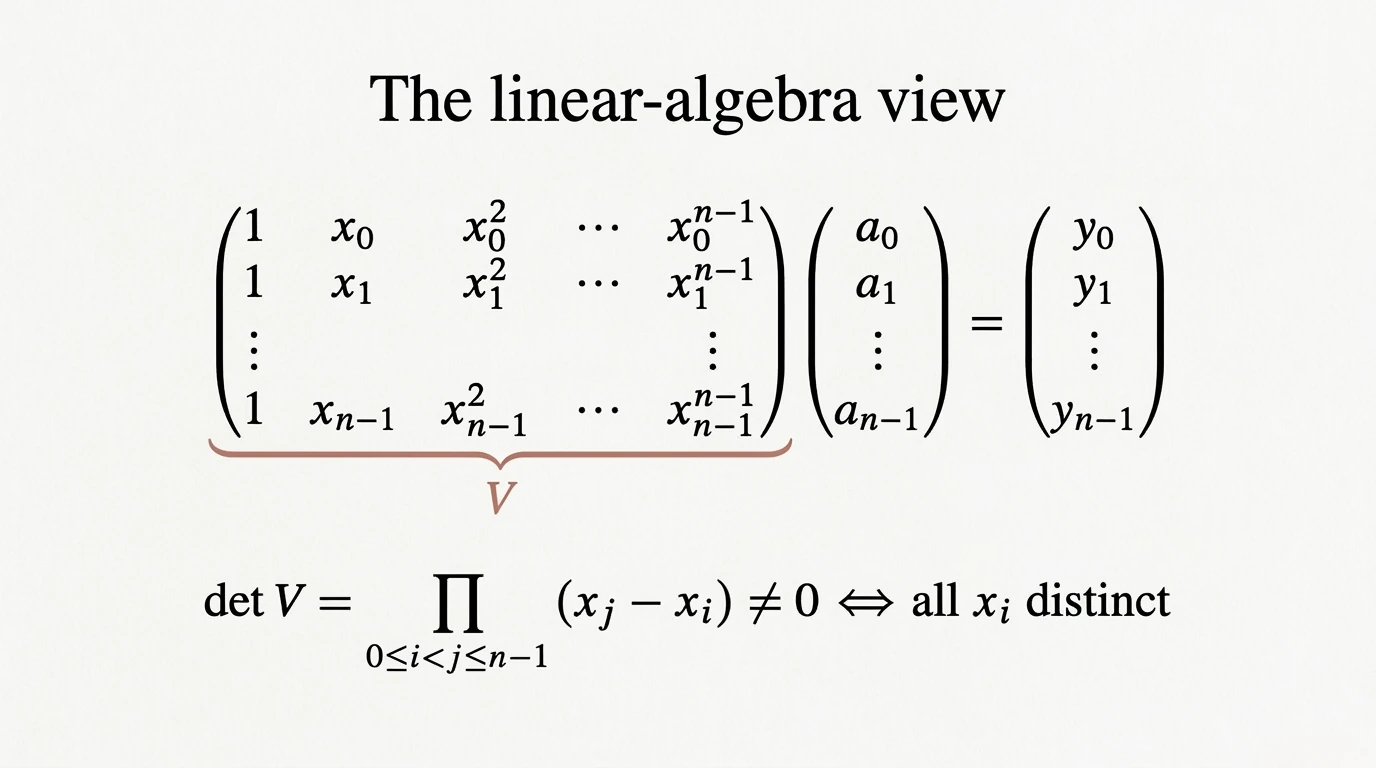
- Avoided constructing ill-conditioned Vandermonde systems, using O(n²) construction and O(n) barycentric evaluation after weight preparation.
- Added symbolic analysis covering factorisation, roots, derivatives and integrals.
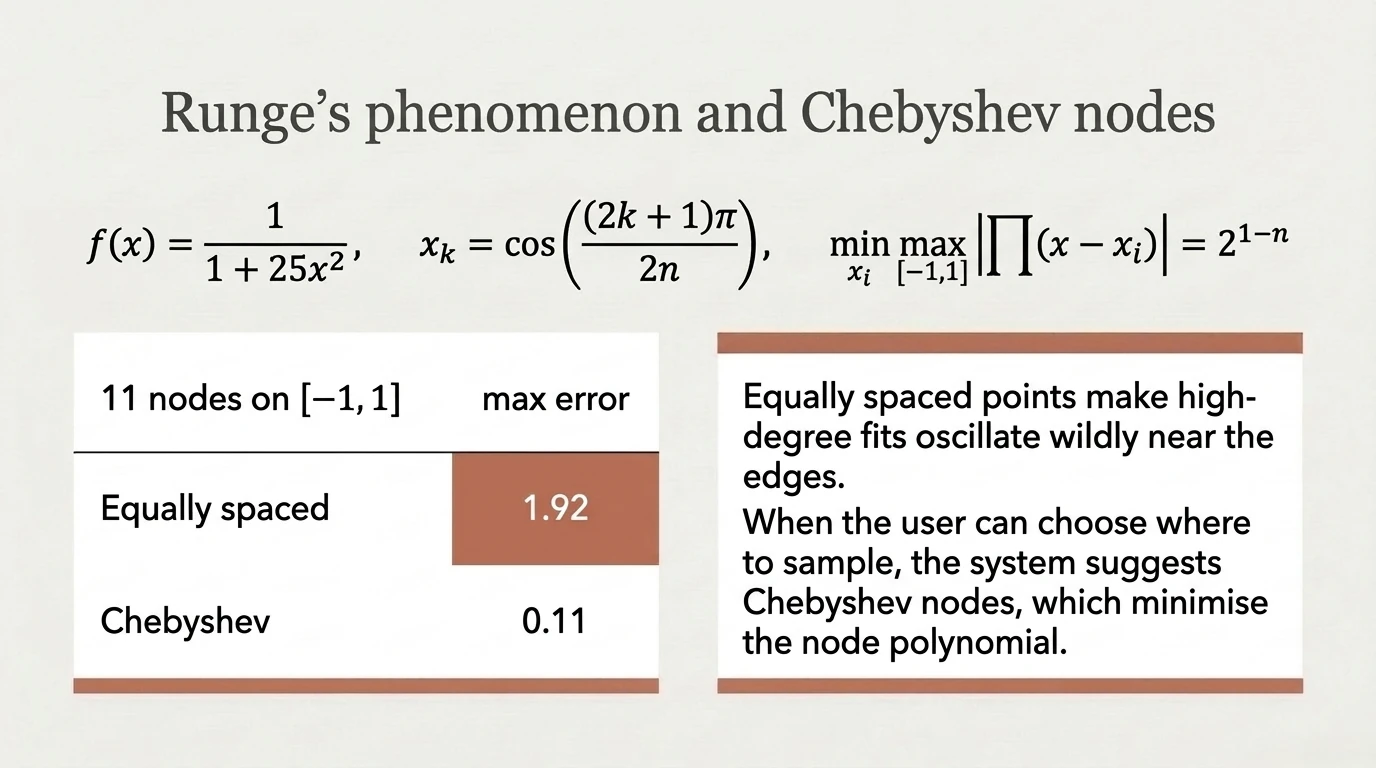
- Accounted for interpolation limitations, including high-degree oscillation and node placement, with Chebyshev sampling guidance.
Outcomes
- N points in, exact coefficients out, with O(n²) construction.
Proven Impact
- Exact rational coefficients with no floating-point rounding.
- Lowest consistent degree detected from the data rather than assumed.
Why It Matters
- Combined numerical analysis, exact algebra and algorithm design into an interpretable mathematical reconstruction system.
Floating point is an approximation. Fractions are a promise.