
Mathematical Programming & Pattern Detection
Sequence Rule Finder
Mathematical Pattern Detection
Jul 2023 – Aug 20234Rule families
nth-termFormulas, predictions and sums
Look Inside
Overview
I independently developed a sequence-analysis program that derives candidate rules from a list of numbers. Instead of merely predicting the next value, it identifies the mathematical structure, derives an nth-term expression and checks whether the rule also explains unused terms.
What It Delivers
- Detection across polynomial, geometric, mixed and recursive sequence families.
- Explicit nth-term or recurrence rules instead of unsupported numeric guesses.
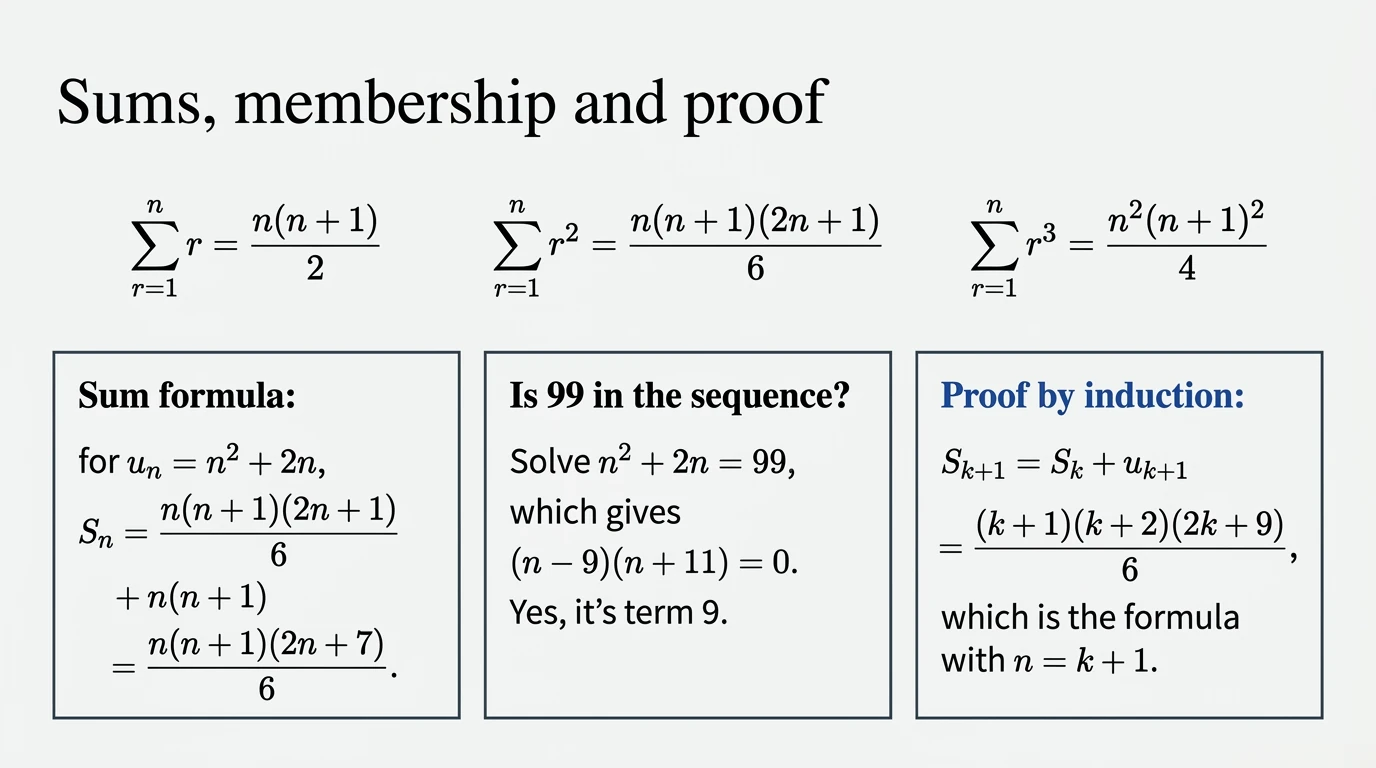
- Sum formulas, predictions and validation checks from the same input.
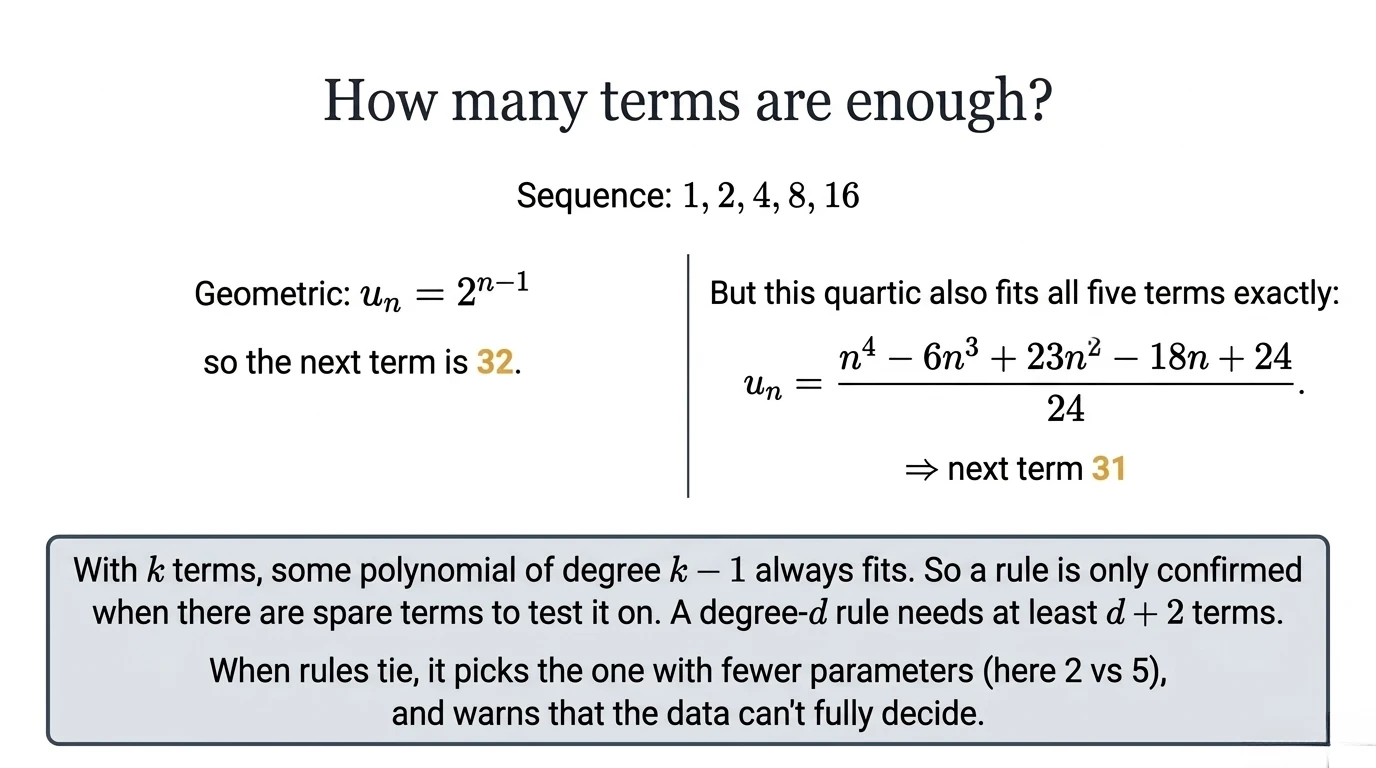
- Clear reporting when a finite sequence admits more than one possible explanation.
What I Did
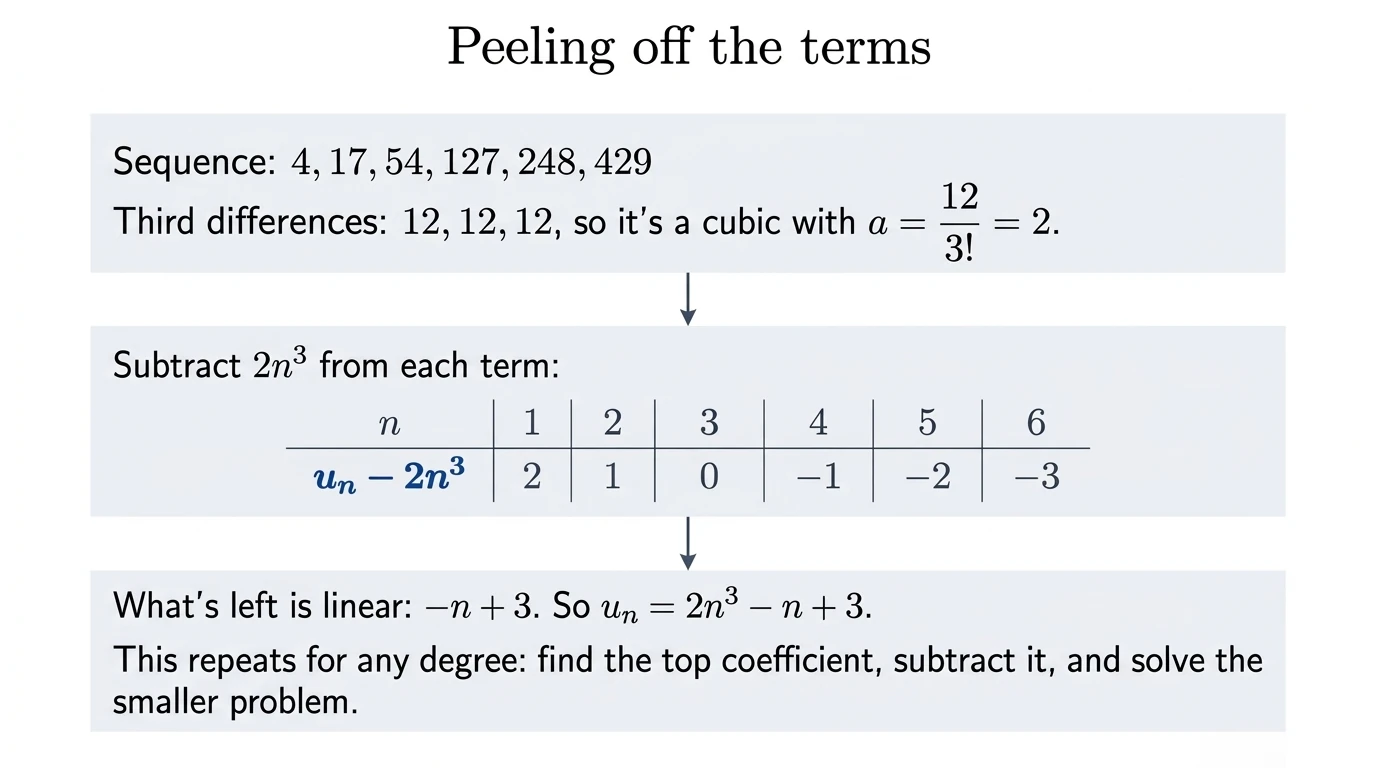
- Implemented finite-difference tables to detect polynomial sequences and identify their degree.
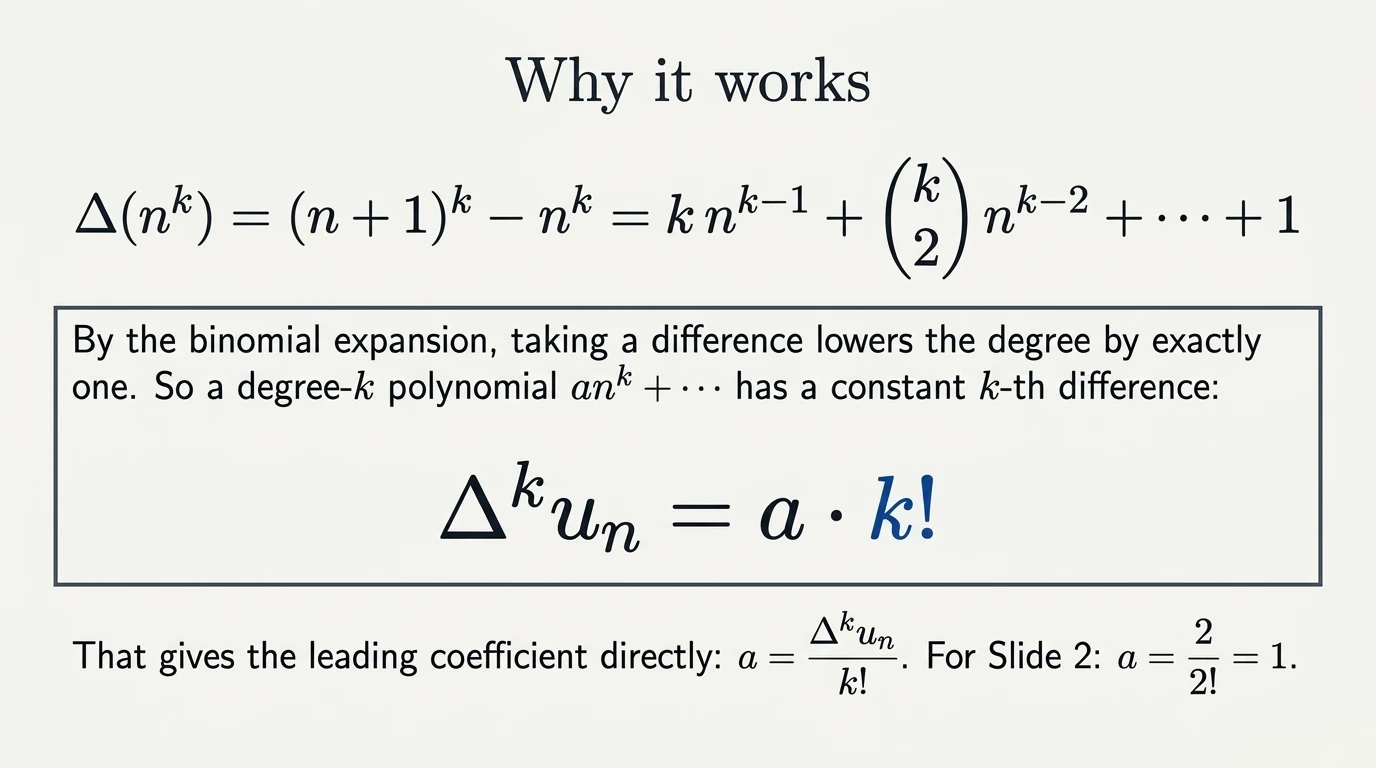
- Derived polynomial coefficients by removing highest-degree terms iteratively, using the kth-difference / k! relationship.
- Added independent cross-checks using simultaneous equations and matrix-based coefficient solving.
- Extended detection to geometric progressions, exponential-plus-polynomial patterns and second-order linear recurrences.
- Built rule validation using spare terms, distinguishing supported patterns from plausible but underdetermined fits.
- Implemented next-term generation, closed-form sums, sequence-membership tests and mathematical verification through induction.
- Designed rule selection to prefer simpler expressions when multiple candidates fit the observations.
Why It Matters
A mathematical programming project focused on deriving and checking explainable rules, rather than relying on visual pattern matching or next-number guessing.